
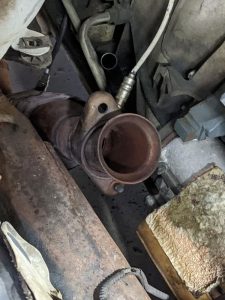
Keeping the air clean is something we all play a part in, and your vehicle’s exhaust system is one of the most important tools in that effort. One key component to the exhaust system is the catalytic converter. Every time your engine runs, the catalytic converter works hard to reduce harmful emissions before they reach the environment.
A catalytic converter is the second major section of your exhaust system, located between the exhaust manifold and the muffler. Its job is to filter pollutants and reduce noise so your vehicle releases cleaner, quieter exhaust.
It’s a Catalyst. You might remember from your chemistry class that a catalyst speeds up a reaction. Inside a catalytic converter, precious metals such as platinum, palladium, rhodium, and sometimes gold act as catalysts. These metals are arranged in a honeycomb structure to maximize surface area. As exhaust gases pass over them, chemical reactions occur that transform toxic gases into less harmful ones.
It’s a Converter. As exhaust enters the catalytic converter, two main things happen:
- Nitrogen oxides are broken apart, releasing oxygen and converting the remainder into nitrogen.-
- Carbon monoxide is combined with oxygen, converting it into carbon dioxide and water vapor.
These reactions dramatically cut down on the pollutants your vehicle would otherwise release. Nitrogen oxides are broken apart, releasing oxygen and converting the remainder into nitrogen. Instead of nitrogen oxides polluting the atmosphere, harmless nitrogen and oxygen are released. Instead of carbon monoxide being released into the atmosphere, harmless carbon dioxide and water vapor exit the tailpipe.
Two Fun Facts About Catalytic Converters. Catalytic converters contain valuable precious metals, which unfortunately makes them a prime target for thieves. They are also sensitive to fuel quality; leaded gasoline will clog and destroy a catalytic converter. This is one of the major reasons modern vehicles use unleaded fuel.
Signs of Catalytic Converter Trouble. If your engine feels sluggish, your exhaust looks darker than usual, or you notice a sulfur-like “rotten egg” smell, your catalytic converter may be failing. Bring your vehicle in and let us be the catalyst that converts your problem back into a smooth, clean-running ride.